Do I need a capture plate or locking plate with my Demco Auto Slide Hitch?
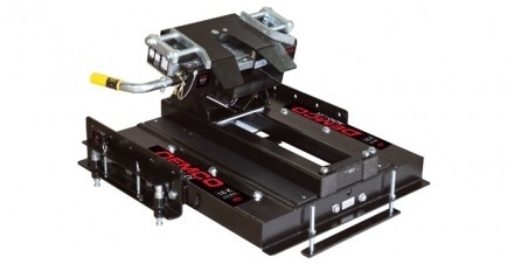
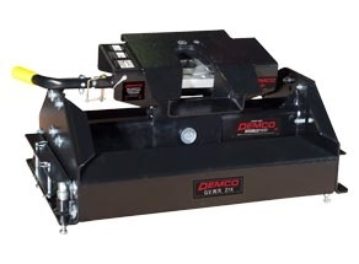
The Demco Auto Slide comes with a Capture Plate system built into the top of the hitch head.
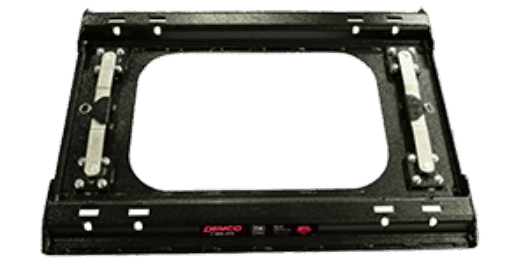
If you have a standard non-suspension pin box, (example: Lippert 1621) nothing else is needed. If you have a suspension pin box or non-conventional pin box, you may need to purchase an additional capture plate. See chart below:
Pin Box: Demco Capture Plate:
Trailair Tri Glide 6095
Trailair Rota Flex 6171
Trailair Flexair 6171
Mor/Ryde Pin-Box 6025
5th Airborne Standard 6026
5th Airborne Extended 6036
5th Airborne 2020 – present 6285
Lippert Turning Point 6285
Gen Y Suspension 6285
Lippert Rhino Box 6335
Demco Glide Ride 6036
How do I properly adjust the built-in capture plates for my Demco Auto Slide?
Measure the width of the pin box. Adjust the capture plates so they are 1/8” wider than the pin box. (1/16” on each side.) Example: if the pin box is 12 inches wide, the capture plates should be 12-1/8” apart. Use the center pin to measure from so the capture plates are centered on the hitch head. Finger tighten the inside two jam nuts against the capture plate mount. Tighten the outside jam nuts against the mounting plate with a wrench.
How to install a 5th wheel hitch?
A 5th wheel hitch needs to be secured to the frame of your truck for proper installation. Installation depends on the truck.
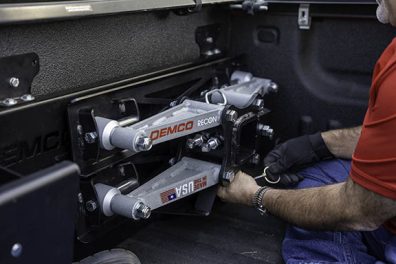
Many trucks now come with a factory installed 5th wheel prep package or what is many times referred to as the “puck” system. Installation into a truck with a factory installed 5th Wheel Prep Package in the truck bed, is a quick and simple. The hitch will need have the specific mounting hardware to match the brand of truck. To installing the hitch, simply insert the securing pins on the hitch into the 4 “puck” holes in the truck bed. Rotate the locking handles closed and the hitch is secured to the truck frame under the bed and is ready for towing.
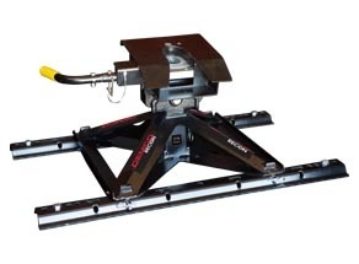
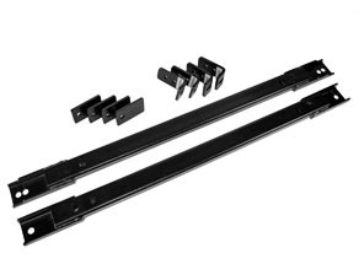
If your truck does not have anything in the truck bed, there are several options available. Installation of frame brackets and bed rails. If your truck bed is not factory prepped, one option is to install brackets to the frame of the truck underneath the truck bed and rails will be installed on the truck bed floor. This installation may require drilling the truck frame to bolt the brackets to the frame (Demco uses as many No Drill Options as we can. No drill means we use existing holes in the frame to install the mounting brackets.) The truck bed will need to have holes drilled in the bed to secure the bed rails to the frame brackets underneath the truck bed. The hitch would then be an ISR (Industry Standard Rail) mount hitch which use 4 pins to attached to the bed rails. The bed rails are permanently attached to the truck bed floor. Also available is a Demco UMS (Under Bed Mounting System). The Demco UMS system gives you the clean bed option like a factory 5th wheel prep package from an aftermarket supplier. Like in the above bed installation, frame brackets will need to be secured to the frame of the truck bed. Again, drilling the truck frame maybe required, however, Demco does utilize many no drill options. The rails are installed underneath the truck bed in the UMS installation. Four holes will need to be drilled in the truck bed floor to allow connection for the hitch to the under the bed bracket system. Once the UMS brackets are installed under the truck bed, installation of the hitch is very similar to the factory 5th wheel prepped application. The hardware used to attached the hitch to the UMS brackets is specific to Demco’s underbed mounting system.
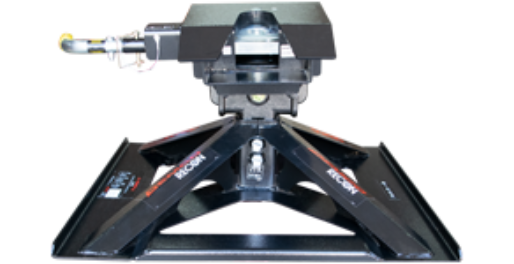
Finally, Demco also has 2 Recon Goose Ball Mounting Hitches available. These hitches require the truck bed has a 2-5/16” goose ball installed in the truck bed. The Recon base then attaches to the 2-5/16” goose ball and converts the goose ball mount to a standard 5th wheel hitch. There are NO adapters and NO pin box modifications, and the standard 5th wheel hitch attachment doesn’t affect the warrant of your trailer frame. There are 2 Recon Goose Ball mounting hitches. One for a standard pickup bed with a 2-5/16” goose ball. A second Recon Recessed Goose Ball mounting hitch is available designed to be used on flat bed trucks with a recessed 23-5/16” goose ball connection.
How does a 5th wheel hitch work?
A 5th wheel trailer has a pin on the trailer called a King Pin. The king pin is attached to an arm or box on the trailer referred to the king pin box. The king pin then slides into a 5th wheel hitch. A 5th wheel hitch has a top head with a skid plate, the skid plate has a horse shoe opening that the king pin slides into and the “jaws” of the 5th wheel hitch close by wrapping around the king pin and securing it into the hitch. A 5th wheel hitch moves the tongue weight of the trailer further forward into the bed of the truck. It also moves the turning point of the truck/trailer combination further forward. Having the tongue weight and pivot point further forward in the truck bed increases the stability the trailer and makes maneuvering the trailer much easier while in motion.
How much does a 5th wheel hitch weigh?
5th wheel hitch weights vary depending on the style of the hitch, stationary, manual slider, or automatic slider. Also affecting the weight of the hitch is the towing capacity of the hitch. Generally, hitch weights will vary, a light weight stationary 5th wheel hitch weighs approximately 100 pounds to an automatic sliding hitch weighing approximately 325 pounds.
How to pull a 5th wheel with a bumper hitch?
It is not possible to safely pull a 5th wheel trailer with a bumper hitch.
What size 5th wheel hitch do I need?
You will need to understand the Gross Vehicle Weight Rating (GVWR) of the trailer you intend to pull. This should be posted on the trailer on a tag that would also contain the vehicle identification number as well as other specifications for the trailer. For example, if the trailer has a gross vehicle weight rating is 17,600 pounds, you would want to purchase a 5th wheel hitch rated at 18,000 pounds or higher towing capacity.